Those who know nothing of foreign languages know nothing of their own
— Goethe.
Welcome to my blog, where I indulge my passion for all things linguistic! Be prepared to discover some weird and wonderful languages you’ve never heard of before, or maybe just to learn more about some languages you thought you knew. While of course all languages on earth can be considered ‘unusual’ in their idiosyncrasies, unique histories and diverse influences, these are the ones that have caught my eye, whether it be on my travels or through more everyday encounters.
If your curiosity has been piqued, feel free to suggest a language for a new blog post in the comments section! Subscribe below to get notified when I post new updates.
Only a few hundred kilometres from Iceland and the Faroe Islands lie the islands of Orkney and Shetland – the northernmost points of the United Kingdom, and home to the now-extinct language Norn.
The Shetland islands were originally a Celtic settlement, until they were invaded by Vikings (the Norse people) during the 9th century AD. They remained a part of the Kingdom of Norway until 1469, when the Norwegian king sold the islands as part of the marriage agreement between his daughter and King James III of Scotland.
Image credit: Hulton Archive/Getty Images
During those six centuries, a unique language had developed, distinct from Old Norse (the ‘Latin’ of Scandinavian languages), which was the main language spoken on the islands. It was known as Norn, and is understood to have been similar to Faroese. Indeed, it was part of the West Scandinavian family of languages (Icelandic, Faroese and Norwegian), as opposed to the East Scandinavian group (Swedish and Danish).
Around the time when the Shetland islands were pledged to Scotland, Norn was gradually replaced by Scots. Norn’s last known speaker, Walter Sutherland, died in 1850, and native, spoken Norn died with him.
Image credit: dfds.com
So what exactly is Scots, the language that replaced Norn? Elsewhere in Great Britain, the invading Angles and Saxons (throughout the 5th to 7th century AD) had given rise to Old English, which spread from England to Scotland during the England-Scotland alliance shortly after the Norman invasion in 1066. Old English was also influenced significantly by Old Norse, as the Vikings did not only invade Shetland, but numerous other places in the British Isles.
Around the time of the alliance, Old English diverged into Middle English in England (the language of Chaucer), and Scots in Scotland. Note that Modern Scots is entirely unrelated to Scottish Gaelic, a Celtic language – it is a sister language of English. Here is the Scots Wikipedia page in Scots – see how much you can understand! Scots is still very much alive in Scotland; roughly 25% of the Scottish population speak or have some proficiency in it.
1800s Scotland, image credit: abdn.ac.uk
So Scots gradually migrated up to Shetland, displacing the Norn language and keeping some of its vocabulary to form the unique Shetland Scots dialect (Shaetlan). Norn survives today only in certain place names and ceremonial usage, such as the Shetland motto Með lögum skal land byggja (‘with law shall land be built’ – technically Old Norse, not Norn).
Image credit: shetland.org
But what was it like? There are very few examples of written Norn, the main ones being a poem called Hildina, and the Lord’s Prayer, below. Note the striking similarities to English in the sections in bold. This is owing to the fact that Old Norse and the ‘German’ languages of the Angles and Saxons were both Germanic languages, plus of course the Norse influence on the Anglo-Saxon languages in England during the Viking invasions.
Fy vor or er i Chimeri. / Halaght vara nam dit.
La Konungdum din cumma. / La vill din vera guerde
i vrildin sindaeri chimeri. / Gav vus dagh u dagloght brau.
Forgive sindorwara / sin vi forgiva gem ao sinda gainst wus.
Lia wus ikè o vera tempa, / but delivra wus fro adlu idlu.
[For do i ir Kongungdum, u puri, u glori.] Amen.
Even though it has been centuries since Norn was the main language of the Shetland Islands, its influence lives on in Shetland Scots. Not only were many everyday words carried over, but so too were some prepositions and pronouns, as well as a Scandinavian intonation. Perhaps Shetland Scots is the closest we can come to hearing what its elusive predecessor Norn sounded like – a window into a forgotten era.
The answer is: halfway between Tomorrow Island and Yesterday Island.
Out in the Bering Strait, off the eastern coast of Siberia and the westernmost point of Alaska, lie the Diomede Islands: Big Diomede and Little Diomede. At their closest points, the two islands are less than 4 kilometres apart – a small stretch of water that conceals not only an international border, but also the International Date Line. Big Diomede, on the Russian side, is 20-21 hours ahead of its Alaskan neighbour Little Diomede, hence the nicknames Tomorrow Island and Yesterday Island.
Image credit: amusingplanet.com
Both islands were inhabited by Inuit communities, specifically the Iñupiat people, for thousands of years before the Russians, and later the Danish, ‘discovered’ them in the 17th and 18th centuries. When the United States purchased the land of Alaska from Russia in 1837, the border was drawn between the two Islands.
Today, the Russian Big Diomede has no permanent population. It was used as a military base during the Second World War, after which the native population was forcibly moved to the Siberian mainland to prevent border crossings. In winter, an ice bridge makes it theoretically (although not legally) possible to walk from the United States to Russia, and, as the inhabitants of the two islands were from the same family groups, they often made this crossing to visit each other. These days, the 29 km2 of icy land is home only to the old military base, a weather station, and a Soviet plane wreck.
Image credit: britannica.com
Little Diomede, known in Inupiaq as Iŋaliq (‘the other one’), is still home to around 82 people, who all live in the same small village on the western side of the island. The island itself is only 7.3 km2, and lies a mere 600 metres from the International Date Line. Aside from a weekly helicopter service to the Alaskan mainland, it is a very isolated community of whalers and ivory traders, with a small school, main store, post office, and small health clinic.
The islanders speak a variety of the Iñupiat language – specifically, the Diomede variety of the Bering Strait dialect (which itself belongs to one of the two Iñupiat dialect groups spoken across Alaska and parts of Canada). The language is closely related to other Inuit languages of Canada and Greenland (such as Kalaallisut, or West Greenlandic). Iñupiaq is considered to be a threatened language, with most of its 2,000 speakers over the age of 40. It is one of the many official languages of the State of Alaska.
Image credit: rickfilms.de
All variants of Iñupiaq have only three basic vowels – a, i, u – and a few related diphthongs. Only the Diomede dialect has the fourth vowel, e. The language is written in the Latin script, with a few small additions, such as ġ, ł and ŋ. Its ‘r’ sound, /ʐ/ (comparable to the French je sound), is increasingly pronounced by younger speakers as the English ‘r’, due to the influence of American English and the number of second-language speakers. The use of tenses is optional, and the concept is usually communicated by an adverb of time – fitting, perhaps, for the people of Tomorrow and Yesterday Island.
Out in the middle of the Pacific, more than 5,000km from Auckland and 6,000km from Panama, lie the Pitcairn Islands – one of the most remote inhabited island groups in the world. A trip there from Europe would require a 30-hour flight to Tahiti, followed by a 4-hour flight to the Gambier Islands and a 32-hour boat trip, on a service which only runs every few weeks. So who are the 50 people who live there, where did they come from, and what language do they speak?
Image credit: Avichai Ben Tzur
While the Pitcairn Islands are technically a British Overseas Territory, they are largely self-governed. They were inhabited by Polynesians for a few hundred years until roughly the 1400s, and were rediscovered by the Portuguese and the British centuries later. In 1787, HMS Bounty set sail from London to Tahiti on a mission to harvest breadfruit trees, with the aim of cultivating them in the Caribbean as a cheap food solution for the enslaved people there.
Replica of the Bounty, built in 1960 Image credit: Dan Kasberger
During their months in Tahiti, some of the crew members became involved with Tahitian women. Mutiny broke out, and instead of returning the Bounty to its port of origin, the mutineers searched for a safe, new life. After some failed attempts elsewhere, nine mutineers and eleven Tahitian women settled on Pitcairn Island, the perfect hiding place, as it had been incorrectly charted on British maps. They then set fire to the Bounty – their final link to the outside world.
The settlement got off to a rocky start, with alcoholism, disease and even murder claiming the lives of many early inhabitants. Nonetheless, its small population steadily grew, and the island eventually became an official British colony in the early 1800s. By the 1850s, the community were outgrowing their island home. Following an appeal to the British government, the islanders were offered an alternative home, and all 150 inhabitants were moved miles away to Norfolk Island, which lies some 1,700km off the coast of Sydney. Homesickness clearly set in, as 34 Pitcairn Islanders returned over the next couple of years. The population peaked at around 250 in the 1930s.
But what language did these people speak? The early relationships between the British men and Tahitian women gave birth to a creole language known as Pitkern – a blend of 18th-century English and Tahitian. Norfuk, the creole language of Norfolk Island, is often considered a dialect of Pitkern; the strong similarity between these two subsequently isolated dialects suggests that Pitkern was well formed by the 1850s, when the languages were separated. On the English side, Pitkern was influenced by the various different accents and dialects of the Bounty crew members; these included English speakers from Newcastle, London, Scotland, and even the Caribbean.
Modern-day Tahitian has around 70,000 native speakers and is part of the Oceanic language family, which also includes Māori, Samoan, Tongan and Eastern Fijian. It is an analytic language, much like English, meaning that it relies on prepositions to show relationships between words instead of different case endings. It is notable in that it only has nine consonants – English consonant sounds such as c, g, y, and w are not used in the language.
So what does Pitkern look like? If you ever find yourself on Pitcairn, you’ll probably want to know wataweih and nais tu ketchup – ‘hello’, and ‘nice to meet you’. You may be asked ata way ye? or ye like-a sum whettles? (How are you? Would you like some food?). ‘I’m going’ is I se gwen – I se gwen ah big shep (I’m going to the ship); I se gwen ah nahweh (I’m going swimming). An excellent example of the written language can be found in Mi Bas Side Orn Pitcairn (My Favourite Place on Pitcairn, 2008), a book written by the children of the island and compiled by Meralda Warren, and the first book to be published in both Pitkern and English.
Press play to hear an example of Pitkern being spoken.
Warren is well known not only for her book, but also for being one of many outspoken critics of Pitcairn’s sexual abuse accusations – a darker element of this unique culture, and one that would be impossible to ignore in an article about Pitcairn. According to residents, girls have always been considered sexually active from the age of twelve, and this practice had been tradition since the island was settled. Pitcairn Islanders have historically rejected British sovereignty, and therefore its legislation, and accusations of underage sex dated back to the 1950s. So normalised was this practice that many of the island’s women have defended it throughout the years, with Warren labelling the 2004 trial a British plot to close down the island, and circulating a poem criticising the British government.
It’s clear to see that 250 years of isolation have left their mark on Pitcairn. The island’s language, traditions, history and people are both deeply mysterious and unique. With the Pitcairn population slowly but steadily falling due to the island’s youth seeking opportunities elsewhere, the island’s future is uncertain. What is clear, however, is the remaining islanders’ fierce pride for their tiny nation, as they fight to ensure that its incredible story will outlive them.
Pitcairn Islanders, 2004 Image credit: Mike Warren
Straddling north-western Spain and south-western France lies a region called the Basque Country, with its own unique language: Basque (or Euskara in Basque). The vast majority (93%) of its 750,000 speakers reside in Spain, while the other 7% live over the French border. Unlike Catalan and other minority languages of Spain, Basque is completely unrelated to Spanish. In fact, it is completely unrelated to every other language in the world.
Imagine almost every language you have heard of in Europe, Western and Southern Asia – from Latvian, Czech and Welsh to Hindi, Russian or Greek. All these languages, believe it or not, share a common ancestor: Proto-Indo-European, spoken around the 5th millennium BCE. Basque, or at least its ancestor Aquitanian, pre-dates them all.
Language map of Europe. Finno-Ugric languages include Finnish, Estonian and Hungarian.
Aquitanian died out during the Middle Ages, leaving Basque as its only descendant. Basque is therefore what is known in linguistics as a language isolate, meaning that it shares no genealogy with any other living language on earth. Isolates of this size are relatively rare; Basque is the only one in Europe, but a small number of much more endangered isolates exist in indigenous communities around the world (somewhat surprisingly, Korean and Japanese are also considered language isolates but not unanimously).
Espelette, a Basque town in France
There are roughly six dialects of Basque. It is a language of many cases, whereby nouns can have a large multitude of different endings to express meaning. Verbs usually go towards the end of sentences, and there is no real grammatical gender (like English). Here is a short history of the Basque language in Basque, to give an idea of the look of the language:
“Iberiar Penintsulan bizirik dirauen erromatarren aurreko hizkuntza bakarra da euskara. Gutxitze prozesu gogorra jasan du, etenik gabe lurraldeak eta hiztunak galduz. Nafarroa Garaian bereziki, prozesu hori nabarmena da. XIX. mendearen bukaeran eta XX. mendearen hasieran, hainbat intelektual eta politikariren eraginez (Arturo Kanpion, Sabino Arana…) nolabait biziberritu zen, abertzaletasunari estuki loturik. Frankismoan (1936-1977) jazarpen latza pairatu ondoren, XX. mendearen erdialdetik aurrera hasi da indartzen, idatzizko estandarizazioari dagokionean, batez ere”.
There are, of course, minor similarities in vocabulary between Basque and Spanish, for example, as the languages have borrowed from each other interchangeably. Crucially, however, the core vocabulary and the entire grammatical system of Basque are of an entirely separate origin.
The paragraph refers to the persecution that the Basque language faced during Franco’s 36-year dictatorship over Spain, ending in 1975. His regime restricted the use of such minority languages in all areas, from publishing to education, and even banned Basque names for new-borns. Towards the end of his dictatorship, a standardised Basque was formed, known as Euskara Batua, which provided a lingua franca for all Basque dialect speakers.
Around this time, a fifty-year conflict ensued between the Basque National Liberation Movement (ETA) and the Spanish government, over the former’s belief that the Basque Country should be a united and self-governed country. There was violence during these years, and many Western nations refer to the movement as a terrorist organisation. It disbanded in 2018.
The Basque region does in fact have its own police force and education system, and the language has co-official status in the Basque Country and neighbouring Navarre. These days, the percentage of support for independence is relatively low, particularly compared to Catalonia on the other side of Spain. Many Basques, however, did express solidarity with the recent push for Catalonian independence, and fervent separatists remain.
Macau is a ‘special administrative region’ of China, much like Hong Kong, with its own government and economic system. Despite its tiny size of 33km2, it enjoys global renown as the world’s biggest gambling hub, an industry which represents 80% of its economy. Its strategic position on the southern coast of China led to its acquisition in 1557 by Portuguese merchants for use as an Asian trading post. The settlement later became an official Portuguese colony until its eventual handover to China in 1999, four and a half centuries later.
Colonial architecture in Macau’s Senado Square
While Portuguese remains a co-official language of the region (with Cantonese), the number of speakers is alarmingly low, perhaps 1% of the total population. Despite the centuries of colonisation, the region remained linguistically segregated. Portuguese was used by the colonists, as the language of administration and of higher education, but its usage did not trickle down into schools or daily communication between locals. The Portuguese spoken was essentially an old variety of the language, more similar to modern-day Brazilian Portuguese, and gained some Cantonese inflection among non-native speakers (the ‘r’ at the end of infinitive verbs was dropped, for instance). In terms of lexicon, borrowings from Cantonese, but also Malay and Sinhalese, were abundant.
While linguistic segregation largely persisted, there were many instances of Portuguese colonists marrying local women, creating a sort of hybrid language known as Patuá – a patois. Patuá is a Portuguese-based creole, incorporating many elements from Cantonese and Malay. An example of the latter is noun reduplication; the plural of ‘casa’ (house) is ‘casa-casa’. Its grammar is somewhat simplified – definite articles are disposed of, and verbs not conjugated.
It is estimated that Patuá only ever had several thousand speakers, as the means of communication between Eurasian Macanese. Today, the number could be as low as 50 in Macau itself, with a few hundred more scattered around the world; indeed, it is considered a ‘critically endangered’ language. The perceived lower status of Patuá discouraged speakers from using it, and the handover of 1999 certainly did nothing to help the situation, as many Eurasians left for Europe. Those left in Macau no longer saw a reason to have their children schooled in Portuguese, and English began to prevail as a second language in its place.
Portuguese language use is therefore dwindling in Macau, particularly in areas of influence; two particularly long-serving Portuguese legal advisers were dismissed without reason a couple of years ago. Around the same time, Portuguese-speaking lawyers were denied a translation of a 66-page Chinese document in a high-profile trial. There are no Portuguese judges left in the criminal court. Macanese lawyer Miguel Senna Fernandes considers it miraculous that Patuá in particular has survived so long, considering the ‘absorbing’ nature of Chinese culture.
Efforts to preserve this unique hybrid language are being made, particularly by the amateur theatre group Doci Papiaçám Di Macau (sweet language of Macau). Their music video Macau Sâm Assi (This Is Macau) is a fantastic showcase of the language – the song is entirely in Patuá, with subtitles in Patuá, Cantonese, Portuguese and English.
One of Patuá’s last remaining speakers is 103-year-old Aida de Jesus, whose daughter Sonia Palmer feels like she is ‘witnessing the last chapter of her people’ (in this interview). Doci Papiaçám Di Macau’s co-founder admits that although the language is dying, their group has prolonged its life thus far and will continue to promote the original language and culture of this unique and multi-faceted coastal metropolis.
If you have ever wanted to break the news to a Greenlander that you don’t speak their language, the above will be a very useful phrase for you. But what language would that be, exactly?
The short answer is Greenlandic. Greenlandic is divided into four main dialects, of which Kalaallisut – West Greenlandic – is by far the most widely spoken (by approximately 50,000 of the language’s 57,000 speakers). Kalaallisut is indeed the only official language of the island, which is a semi-autonomous territory of the Kingdom of Denmark. While Danish is very widely spoken in Greenland and is the first language taught in schools there, it lost its official status in 2009 in a bid to protect the Greenlandic identity.
Kalaallisut is a member of the Inuit language family, and is therefore closely related to other indigenous Inuit languages of northern Canada and Alaska. It is, however, unique among these in being the sole official language of its territory. As you may observe in the title of this post, Kalaallisut is a polysynthetic language, meaning that long words can be created by adding prefixes and suffixes to a root word (rather like German), condensing even whole sentences into single words. A fantastic example of this can be seen in this short video. Notably, it also has a lack of grammatical tense; the time of an action must be deduced by its context or sometimes by additional suffixes.
The language was not always written in our familiar Latin script; this was a change that came about during the Danish colonisation in the 1700s. Its orthographic system underwent an extensive reform in the 1970s in an attempt to simplify the written language for the purposes of young learners. Current literacy rates in Greenland are among the very highest in the world.
A bilingual ‘no parking’ sign in Danish and Greenlandic
While Greenlandic has borrowed many words from Danish, its structure is very favourable to the creation of new, native compound words out of words that already exist in the language. For the relatively modern word ‘computer’, Greenlanders came up with qarasaasiaq: an artificial brain. Countless new words can be generated in this way simply by stacking additional affixes onto existing root words.
If you ever find yourself in Greenland, you might want to say more than just the fact that you do not speak the language. The easiest place to start is with the simple aluu and baaj, both products of the US military presence during the Second World War. Qujan is thank you. You might also wish to ask tuluttut oqalusinnaavit – do you speak English? Click here to discover more phrases.
If you do ever meet a Greenlander, it is perhaps more likely to be on the Danish mainland, where approximately 316 Greenlanders move every year in search of a new life. Life can be tough on the island, and suicide is alarmingly common, particularly among youths. The transition into Danish life is far from easy, however, and many Greenlanders face unemployment and even homelessness on arrival; legally, they are Danish citizens so do not benefit from immigration initiatives (this article provides a sobering account of this issue). While it is too contentious an issue to be properly addressed here, there has been a push for independence from many Greenlanders over the last few decades. Indeed, as the Danish Prime Minister said in Nuuk just last year: ‘Greenland is not Danish. Greenland is Greenlandic’.
East Greenland football championships in Tasiilaq. Photo credit: Mads Pihl
Have a look at this well-known text below. Prizes go to anyone who can identify the language, with the top prize for anyone who can recognise what the text is.
That’s right, it’s the Lord’s prayer, in English! Not modern English of course, but Old English, from c.800 AD. Didn’t recognise it? Have another look (and bear in mind that þ and ð both represent a ‘th’ sound).
Although fascinating to look at, it certainly isn’t easy to decipher, owing predominantly to the huge swathes of foreign loanwords that have entered the English language since the time of writing. In fact, it is estimated that only 20-33% of our lexicon is ‘native’ to us, while around 28% is made up of French borrowings, largely due to the Norman invasion, with a further 28% directly from Latin (with numerous smaller contributors from around the world too). Just consider some of the words in the previous sentence; ‘native’, ‘largely’, ‘invasion’, and ‘directly’, among others, are all of Latin origin, whether direct or indirect.
The story of English can be loosely broken into four chapters. Following Old English was Middle English (think Chaucer), followed by Early Modern English (the language of Shakespeare), and finally Late Modern, more or less the language we speak today. The example sentences below provide a quick and interesting reference point.
All this begs the question: what is Anglish? Anglish is essentially a hypothetical version of modern English, stripped of all Romance (and Ancient Greek) influence. This can be achieved through careful selection of native words (favouring ‘begin’ over ‘commence’, for example), by creating possible new words from Germanic roots (such as ‘wordbook’ instead of ‘dictionary’), or by resurrecting old words that have fallen out of use.
While such linguistic purism has existed for hundreds of years, the term Anglish was coined in the 1960s by journalist Paul Jennings. Despite Anglish’s lack of standardisation, it does boast its own literature, the chef d’œuvre being Poul Anderson’s Uncleftish Beholding (1989) – an account of atomic theory, in case you didn’t get that, entirely stripped of all the Latin and Greek terminology that makes up so much of our modern scientific vocabulary. ‘Uncleftish’ is an Anglish calque of the Greek-derived word ‘atom’, which literally means ‘uncuttable’, while ‘beholding’ is an alternative for theory. To achieve such a linguistic feat, Anderson relies heavily on Germanic calques, using ‘sourstuff’ for oxygen, and ‘waterstuff’ for hydrogen. ‘Bulkbit’ is a molecule. Here is a short extract for your enjoyment, or bewilderment, as the case may be.
‘Most unclefts link together to make what are called bulkbits. Thus, the waterstuff bulkbit bestands of two waterstuff unclefts, the sourstuff bulkbit of two sourstuff unclefts, and so on.’
Despite being purely hypothetical, Anglish enjoys the support of a loyal online community, namely the Anglish Moot fandom page – essentially an alternative Wikipedia, with all entries entirely in Anglish. Have you ever wanted to read about Shakespeare, the Italian language or World War II without any of those pesky foreign loanwords? This is your place. Among the articles is a wonderfully executed description of the Star Wars saga. A long time ago in a starset far, far away …
‘The brand began in 1977 with the first showing of the film Star Wyes (later undernamed Follow Four: A New Hope in 1981) and it swiftly became a folkcouth happening. Two more afterfollows were made called “The Rich Strikes Back” and “Comeback of the Jedi”. These first three films make up the First Thrilock.’
While Anglish may be entirely useless, it is nonetheless a hilarious study in linguistic pride and a thought-provoking demonstration of the extent of foreign influence on English, without which we would not have wonderfully rich and expressive language we have today.
The answer is Dhivehi, an offshoot of the Indo-Aryan language family (which contains over 200 languages spread over India, Bangladesh, Nepal, Pakistan and Sri Lanka, among others). Dhivehi bears some resemblance to Sinhalese (the language of Sri Lanka), the two being quite separate from their continental relatives. This said, they are by no means the same language; Dhivehi has a different writing system and has also been heavily influenced by Arabic, as well as many other languages such as French and Persian.
The name Dhivehi is the Sanskrit word for islanders, and is linked to the name of the Maldives itself; dvīpa is an Old Indo-Aryan word for island.
While the Dhivehi language actually comprises multiple dialects, some of which are not even mutually intelligible, the accepted standard is that of the capital, Malé. English is also widely spoken and is, in fact, the language used in Maldivian schools.
Dhivehi has its own writing system called Thaana, a largely phonemic alphabet unique to the Maldives. It is written from right to left and contains many elements derived from Arabic, as well as some Indic influence. Its earliest written example dates from the 1500s. An example of this unique and slanting script can be seen below.
The 1970s ushered in a great period of uncertainty for the traditional Thaana script; the advent of Telex machines on the islands forced the government to transliterate messages into the Latin script, the only one supported by the machines. This transliteration has been criticised by linguists for its many inconsistencies with the Latin transliteration of the Arabic script, but still exists today alongside the Thaana script, which was officially reinstated in 1978. Some examples of basic Dhivehi words with their Latin transliterations can be seen below. English even has a small number of Maldivian loanwords, such as ‘atoll’, the word for a ring-shaped coral reef or group of islands, of which this unique island nation is a perfect example.
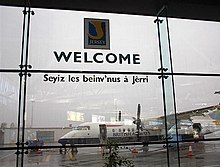
Jèrriais is a language spoken on the island of Jersey (Jèrri), one of the Channel Islands, lying between England and France. Jersey is a British Crown Dependency (like Guernsey, and the Isle of Man), and is not a part of the United Kingdom, however subscribes to many aspects of British culture. Most notably, English is its main language, its currency is the pound sterling, and cars drive on the left side of the road. While Jersey’s total population is approximately 98,000, Jèrriais is very much a minority language, with roughly 1,900 native speakers (and a further 2,800 second-language speakers). It is nonetheless one of the two official languages of Jersey (and nearby Sark), alongside English.
Jersey lies just off the coast of Normandy, France, and did indeed belong to the Duchy of Normandy for many decades, before William the Conqueror (Duke of Normandy) famously attacked and conquered England in 1066, becoming its king. Subsequent kings of England eventually lost the region of Normandy at the beginning of the 13th century, but the Channel Islands remained under English rule, and have done until the present day.
So what is the language like? Jèrriais is essentially a dialect of Norman French, and is largely mutually intelligible with the mainland Norman language. It therefore shares many traits with modern standard French, and can be understood to some degree by native French speakers (this is not to say that they are mutually intelligible). Here are some examples of single words with their French and English translations for comparison (source: Wikipedia).
Jèrriais
French
English
Jèrri
Jersey
Jersey
beinv’nu
bienvenue
welcome
bel
cour
yard
bieauté
beauté
beauty
bouônjour
bonjour
hello
brînge
brosse
brush
chièr
cher
dear
pouque
sac
bag
janmais
jamais
never
lian
lien
link
viages
voyages
journeys
Like many minority languages, proficiency in Jèrriais is highest among the older population. According to the Jersey Annual Social Survey in 2012, more than 7% of residents over 65 were fluent in the language. 18% of the population could understand some Jèrriais words and phrases. Up until the 19th century, however, it was the main language for the majority of the population. Today, efforts are being made to safeguard it against the linguistic dominance of English on the island. There is a native newspaper as well as a BBC radio programme (to listen to an example, click on this link https://www.bbc.co.uk/sounds/play/p087s9x6). The language is also featured on Jersey banknotes, and as of last year is set to be used on signage and official letter headings. While Jèrriais was replaced by English in schools in 1912, modern-day primary schools often offer Jèrriais lessons, to pass an appreciation for this unique language on to the next generation.
Barossadeutsch, as it is known in German, is a German dialect with only a handful of modern-day speakers, spoken in the Barossa Valley in the Australian state of South Australia. How did this come about? German was first spoken in the Barossa Valley in the 1840s, as a result of the mass migration of German Lutherans fleeing religious persecution in Prussia – a kingdom and then republic that spanned present-day Northern Germany and Poland, as well as parts of several neighbouring countries. Germans actually formed the largest non-English-speaking group in Australia up until the 20th century.
The advent of World War I resulted in a swift decline in the number of German speakers in Australia. Many Germans were interned without reason, and any new German immigration was officially banned from 1914-1925. Anti-German sentiment also resulted in many place names being anglicised, as well as the closure of Lutheran schools. The Moculta Lutheran School, for example, was closed in 1917 despite pleas to keep it open and even the promise to teach solely in English. This was much to the disappointment of students and the local congregation. Even after the opening of the new Moculta School just days later, for many years new Grade 1 students would arrive unable to speak a word of English.
So what is the language actually like? The prominent South Australian writer, Colin Thiele (1920–2006), whose grandparents were German immigrants, referred to “Barossa-Deutsch” as: “that quaintly inbred and hybrid language evolved from a century of linguistic isolation”. As most of its speakers hailed from Prussia and Silesia, it is classed as a Central German dialect, and therefore remains relatively close to modern standard German (when compared to other German sprachinseln around the world), although includes many instances of Australian English vocabulary and hybrid grammar.
It is very difficult to put a figure on the number of surviving speakers, but despite decades of institutionalised linguistic repression and anti-German sentiment, there is clear evidence of the language being spoken in the last few years, as demonstrated by the article about a South Australian man lamenting the death of his last German-speaking friend: Simon Royal, March 2017 https://www.abc.net.au/news/2017-03-26/keeping-south-australias-barossa-deutsch-alive/8375988.
Here is the only written example of the language I have been able to find (in the State Library of South Australia). It is a humorous poem, about a woman wondering when her son Johnny will finally get married. For those who speak standard German, the influence of English loan words and even grammatical structures is very evident.




 Unusual Languages of the World